

P.S: 80% of the content and thoughts in this article are written by me, but I did use AI to format it better.
I’m sure most of us have been affected by the recent Cloudflare outages — and apparently a few other outages across the hyperscalers too. They feel a bit more frequent than what we were used to earlier.
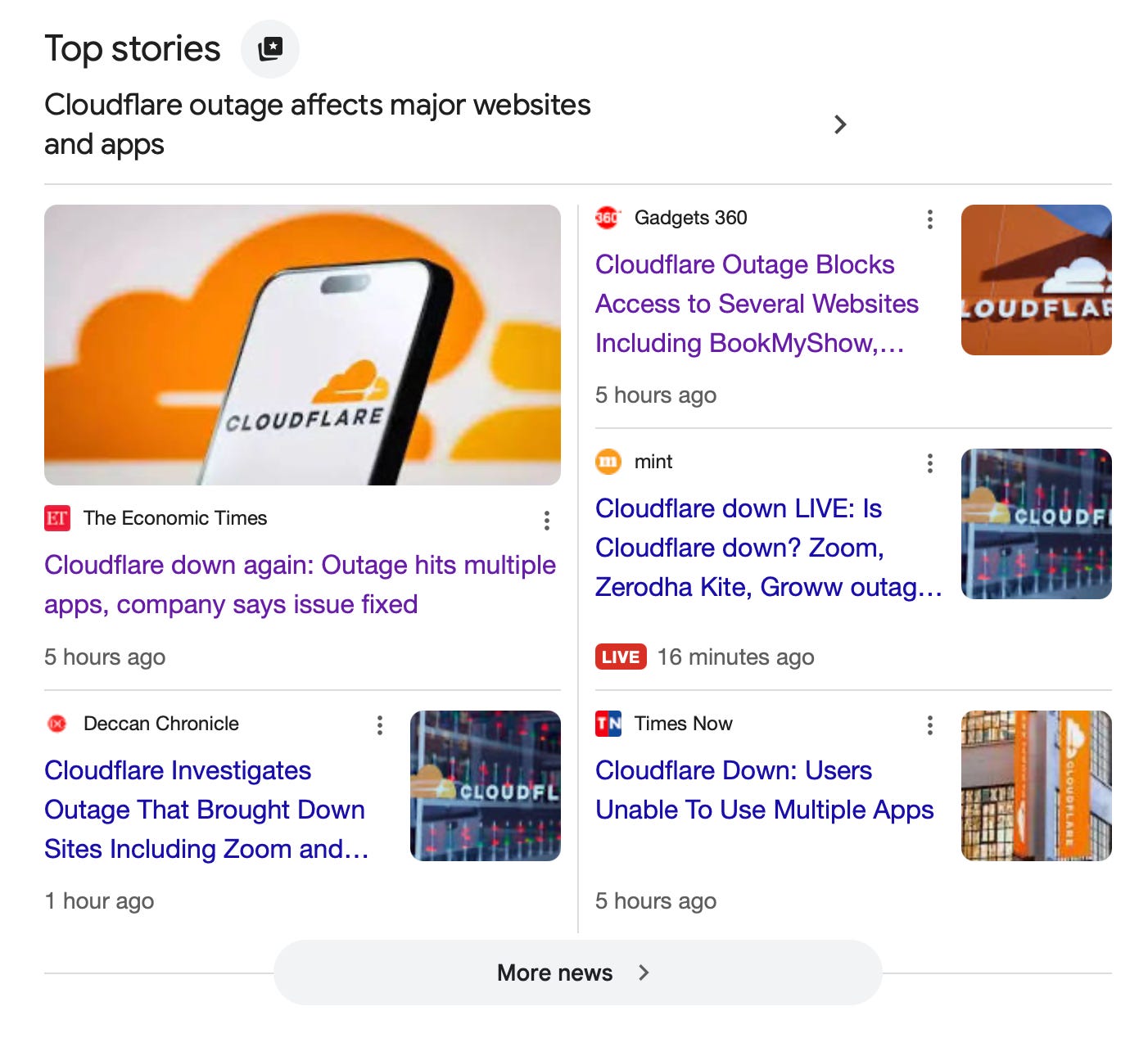
Most of these incidents already have published root causes: DNS-related issues, feature files ballooning in size, config drift… the usual. Nothing points directly to AI-generated code. But it’s been on my mind — what happens when 82% of developers are using AI code assistance every single day? When AI-generated or AI-touched code quietly enters production systems at scale? And when studies say this code is only 30–70% accurate depending on the tool?
what happens when we are all writing code faster than we can review it?
Now, personally, I don’t believe the recent outages were caused by AI. But I do think we’re entering a period where more outages will be influenced by it. And ironically, that might be the biggest signal that something truly transformative is happening underneath.
I’ll stress that again — the chaos itself is a sign of change.
The Silent Contributor
Source: Stackoverflow Survey
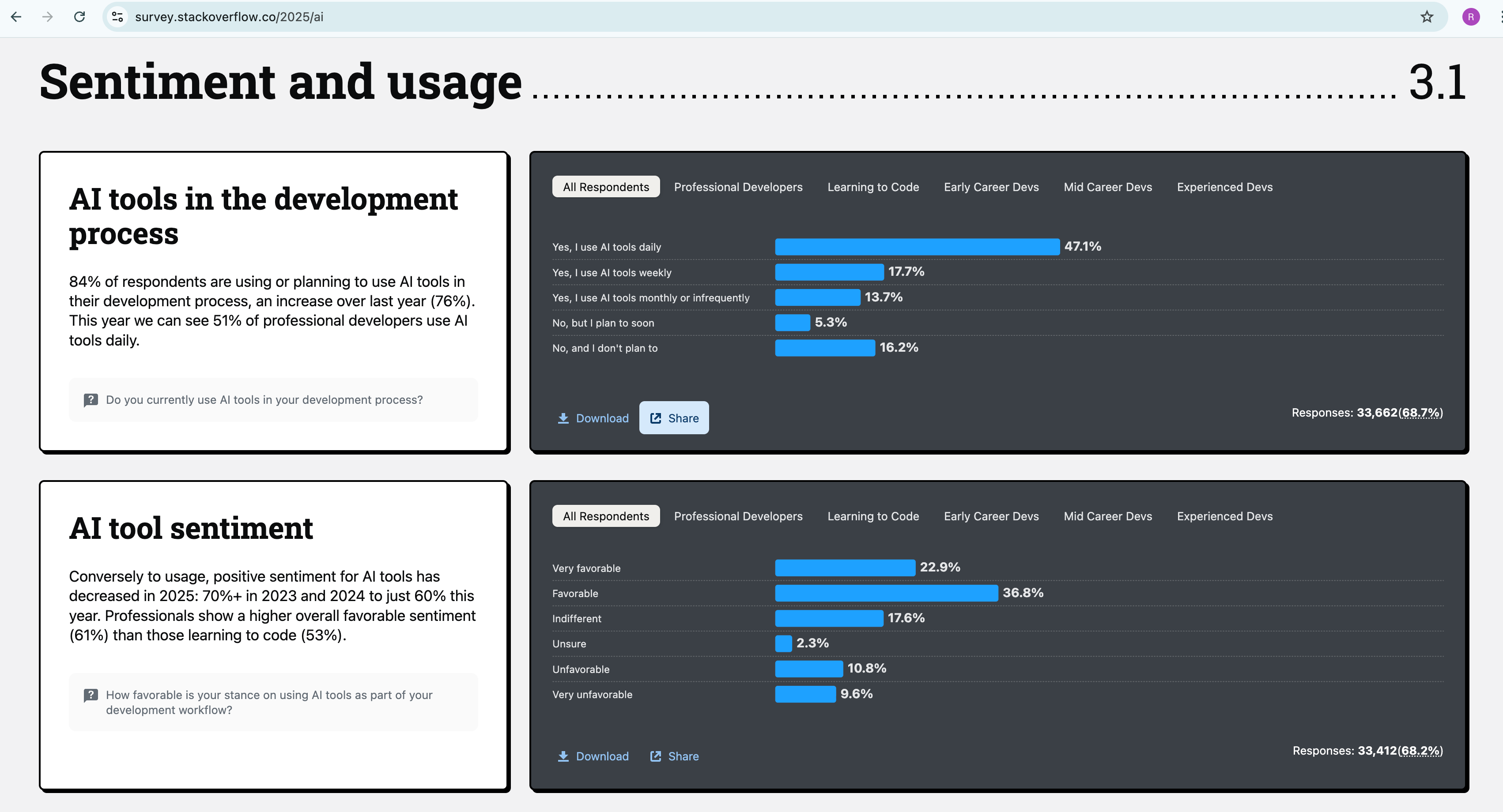
Eighty-three percent of firms now use AI to generate code, with 57% treating AI coding tools as standard practice. One in four enterprises with 100+ engineers has moved beyond testing into active production use. AI-generated code is approaching parity with human-written code in many development teams.
the alarming thing isn’t about ai generating so much code
but, developers are shipping this code anyway.
because it’s fast.
because it looks right.
Most importantly
because the pressure to deliver hasn’t decreased—it’s only increased now that everyone knows AI can write code in seconds.
The Twenty-Year Compression
Here’s the thought that keeps me up at night—and also gives me hope.

The internet era took two decades to mature. From the chaos of Web 1.0, through the bubble, through the slow professionalization of web development, through the rise of cloud computing and SaaS, through DevOps and CI/CD and infrastructure as code—it took roughly twenty years for “building software” to become a reliable, repeatable, enterprise-grade discipline.
Twenty years of accumulated best practices. Twenty years of learning how to test, deploy, monitor, and roll back. Twenty years of building the institutional knowledge that makes modern software development possible.
AI-assisted development won’t take twenty years. I’d argue it will take two.
Not because AI is magic, but because the infrastructure already exists. The cloud is built. The deployment pipelines are mature. The monitoring tools are sophisticated. The feedback loops are measured in minutes, not months.
When AI writes bad code in 2025, we find out fast. When a deployment fails, we can roll back automatically. When an incident occurs, we have the observability to trace it to its root cause. The system is designed to surface problems quickly.
More importantly, AI learns from failure at a scale humans never could. Every bug report, every stack trace, every incident review becomes training data. The models that write code in 2026 will have learned from the mistakes of 2025. And the models of 2027 will have learned from both.
We’re not just building software anymore.
We’re building systems that build software.
And those systems improve on a timeline that isn’t bound by human learning curves.
The Chaos Is the Signal
So what should we expect?
In the next six to twelve months, we’ll likely see more incidents explicitly attributed to AI-generated code. Not because AI is getting worse, but because AI is getting everywhere. When AI-touched code reaches true parity with human-written code—when it’s in half of all production systems—it will statistically be involved in half of all incidents.
This will generate headlines. “AI Code Causes Major Outage.” “Company Loses Millions to AI-Generated Bug.” The narrative will be that AI is dangerous, that we’ve moved too fast, that we need to slow down.
The narrative will miss the point.
The point is that every major technological shift involves a period of instability. The early days of the automobile were more dangerous than horse-drawn carriages. The early internet was a security nightmare. Early cloud computing had spectacular failures that made enterprises swear they’d never trust their data to someone else’s servers.
And then, each time, the technology matured. Standards emerged. Best practices solidified. What was once risky became the new baseline of safety and reliability.
AI-assisted development is following the same pattern, just faster.
The Other Side
Here’s what I believe.
We’re not heading toward a world where AI makes software worse. We’re passing through a turbulent transition on the way to a world where AI makes software dramatically better.
The outages we’re seeing—whether or not they’re AI-caused—are symptoms of a system under stress. We’ve built infrastructure that connects everything to everything. We’ve created dependencies so deep that a DNS error in Virginia can ground flights in Alaska. We’ve concentrated critical services in a handful of hyperscalers whose mistakes ripple globally.
AI didn’t create that fragility. But AI will be part of the solution. Systems that can predict failures before they happen. Code that can heal itself. Infrastructure that can route around problems in real-time.
We just have to get through the messy middle first.
The internet took twenty years to grow up. AI-assisted software development will do it in two. And when we look back from 2027, the chaos of 2025 will look like exactly what it was: the growing pains of a technology that was about to change everything.

The question isn’t whether AI will transform how we build software. That’s already happening. The question is whether we’ll navigate the transition with our eyes open—prepared for the turbulence, invested in resilience, and focused on the remarkable stability waiting on the other side.
Signing off this Friday with these thoughts!
Thank you for reading!
Have a happy weekend :)
Best Regards
Rohith Reddy Gopu!
Very practical outlook